Writing
JEDIWOLF VAULT
BY
MILK
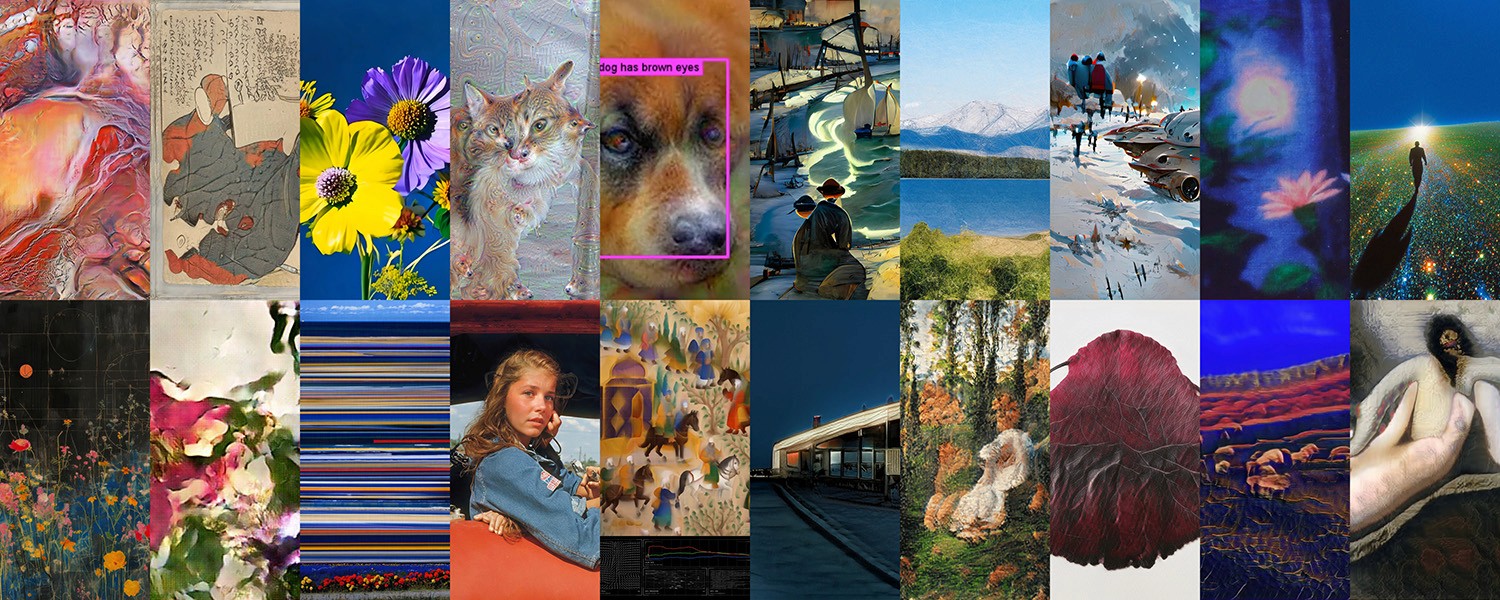
Welcome to the third edition of VAULT, where we explore the vaults of notable collectors across the digital art space and spotlight the artists and artworks that make up their collections. This edition features Jediwolf.
Welcome to the third edition of VAULT, where we explore the vaults of notable collectors across the digital art space and spotlight the artists and artworks that make up their collections. This edition features Jediwolf.
@randomcdog is an anonymous curator-collector and researcher who began collecting at an early age. As a teenager, oil paintings by artists such as J.M.W. Turner and Ivan Aivazovsky were Jediwolf's introduction to the arts, initiating his passion for creativity and collecting.
Over the years, Jediwolf has significantly contributed to the provenance of early GAN creations through his personal AI art research project, recently brought to life within the early AI art timeline on Ethereum.
UnderTheGAN is focused specifically on early AI art, created years before Midjourney and Stable Diffusion were released and before the holistic genre of AI art (GAN, Image / Video Gen, etc.) exploded beyond imagination.
Jediwolf's collecting practice also specializes in early XCOPY editions, which he began acquiring at the start of the bear market in 2022. The first edition he collected was Taxmen (2019, Edition: 20/20 KO) and one of the most notable XCOPY pieces in his collection is Last Selfie (#1), a 10/10 edition.
His love for X and passion for curating his own collections, whilst improving them and supporting fellow collectors, culminated into the co-founding of @thedoomedxyz, a mutual initiative to collect XCOPY art as a group of over 120 people.
Background courtesy of @KateVassGalerie
The art in this article was incredibly difficult to narrow down to given the vast amount of exceptional early AI/GAN works that live in this collection.
The focus wasn't to provide a chronological list of all the pioneering artists in the field of AI, recorded on-chain (recommend exploring UnderTheGan), but rather spotlight a selection of my favorite technical, visual, and conceptual pieces. The works below have been curated to showcase the vault.
@randomcdog is an anonymous curator-collector and researcher who began collecting at an early age. As a teenager, oil paintings by artists such as J.M.W. Turner and Ivan Aivazovsky were Jediwolf's introduction to the arts, initiating his passion for creativity and collecting.
Over the years, Jediwolf has significantly contributed to the provenance of early GAN creations through his personal AI art research project, recently brought to life within the early AI art timeline on Ethereum.
UnderTheGAN is focused specifically on early AI art, created years before Midjourney and Stable Diffusion were released and before the holistic genre of AI art (GAN, Image / Video Gen, etc.) exploded beyond imagination.
Jediwolf's collecting practice also specializes in early XCOPY editions, which he began acquiring at the start of the bear market in 2022. The first edition he collected was Taxmen (2019, Edition: 20/20 KO) and one of the most notable XCOPY pieces in his collection is Last Selfie (#1), a 10/10 edition.
His love for X and passion for curating his own collections, whilst improving them and supporting fellow collectors, culminated into the co-founding of @thedoomedxyz, a mutual initiative to collect XCOPY art as a group of over 120 people.
Background courtesy of @KateVassGalerie
The art in this article was incredibly difficult to narrow down to given the vast amount of exceptional early AI/GAN works that live in this collection.
The focus wasn't to provide a chronological list of all the pioneering artists in the field of AI, recorded on-chain (recommend exploring UnderTheGan), but rather spotlight a selection of my favorite technical, visual, and conceptual pieces. The works below have been curated to showcase the vault.
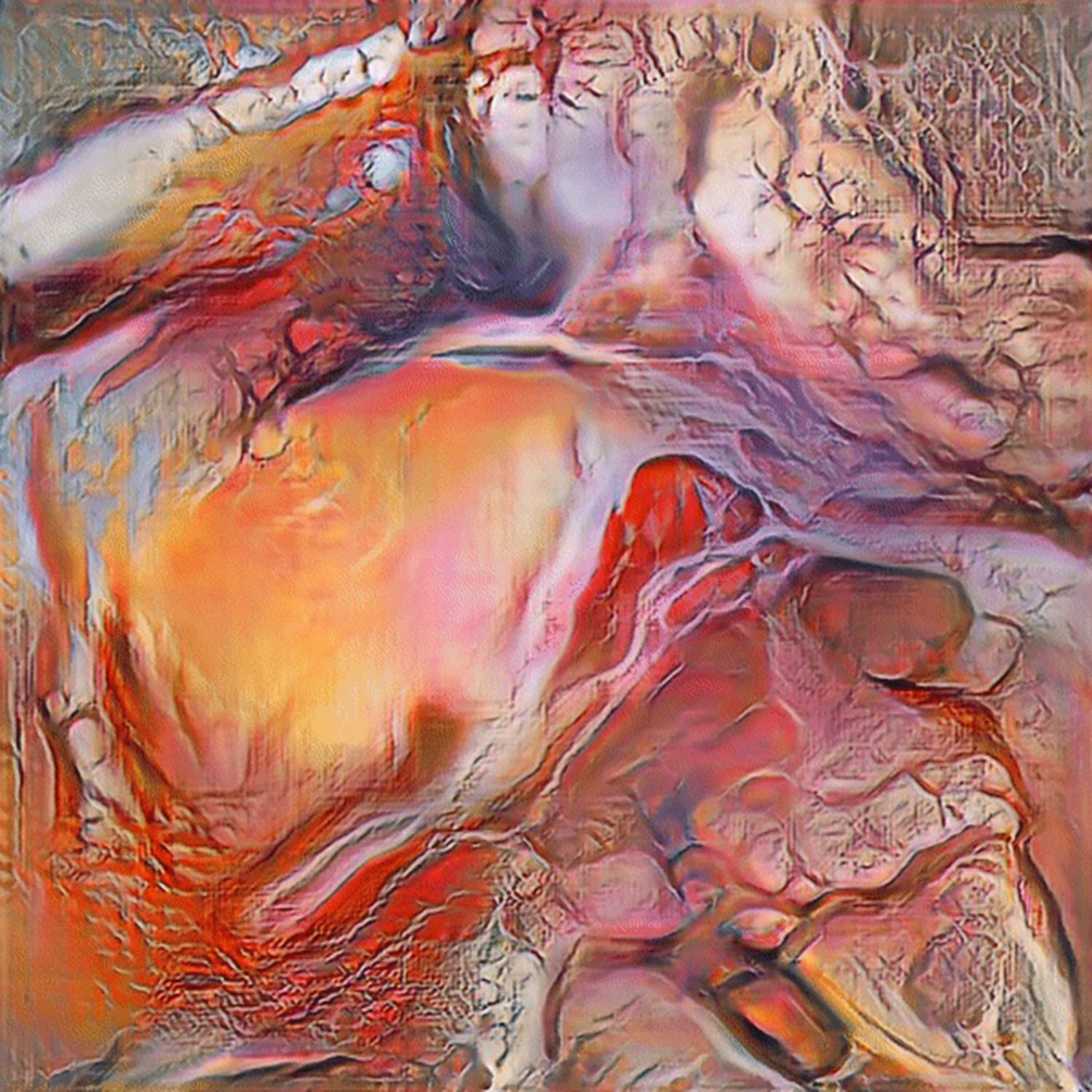
Acryl 008-9650-130
Hans Brouwer, aka Wavefunk, is a generative deep learning specialist, visual artist, musician, and DJ, interested in creative applications of deep learning for image, audio, and video synthesis.
Acryl 008-9650-130 is an interpolation in the latent space of a GAN, trained on pour painting style transfers with latent vector changes, controlled via 8 MIDI knobs.
"The first ProGAN I trained and the first dataset I made using my recombinant style transfer technique started with acrylic paint and pour art. The dataset was too small for ProGAN, despite the style transfer amplification, although it did manage to avoid mode collapse all the way to the full 1024x1024 resolution."
Seeds 70045
Yuma Kishi is a contemporary artist using artificial intelligence to create data-driven digital works and sculptures. Reinterpreting AI as “Alien Intelligence,” Kishi explores the concept of an “alien subjectivity” that emerges from the symbiotic relationship between humans and AI.
Borrowing motifs and symbols from the canons of both Western and Asian art history, his paintings distort our perceptions of the history of aesthetics, evoking a sense of momentary dislocation in the viewer’s awareness of self; creating a liminal space in between the here and now.
Seeds 70045 is a video installation utilizing AI to reinterpret Ukiyo-e: a genre of Japanese woodblock prints and paintings depicting scenes of landscapes and urban life; focusing on culture, entertainment, and the fleeting nature of the world.
F1-GNS01 Fifth Generation
Linda Dounia is a Senegalese-Lebanese artist, designer, and writer interested in the philosophical and environmental implications of technocapitalism. She is an advocate for greater agency over algorithms—how we perceive them and are perceived by them.
Her artistic practice mediates her memories as alternative realities and evidence of excluded ways of being and doing; formed through the dialogue and tensions between lived experience, code, and AI.
Once Upon A Garden is a speculative archive of critically endangered and extinct flora that we have little to no record of. The series utilizes AI as a time machine to piece together unrecorded data using what has been recorded as its dataset to fill the gaps in the world’s collective memory.
Between 2021 and now, Linda has speculated on what the flora population in West Africa might have looked like, decades ago, using increasingly faster and more refined models. The final chapter of the series, titled Synthetic Rot, is the culmination of this body of work, spanning four years.
It traces generative AI models’ evolution over this period and their ability to help us synthesize the past. The Fifth Generation presents stills and videos of randomly assorted flowers, composed of mostly inorganic material, exposing the fact that they're primordial data mediated through screens by code, made possible by machinery built with natural resources.
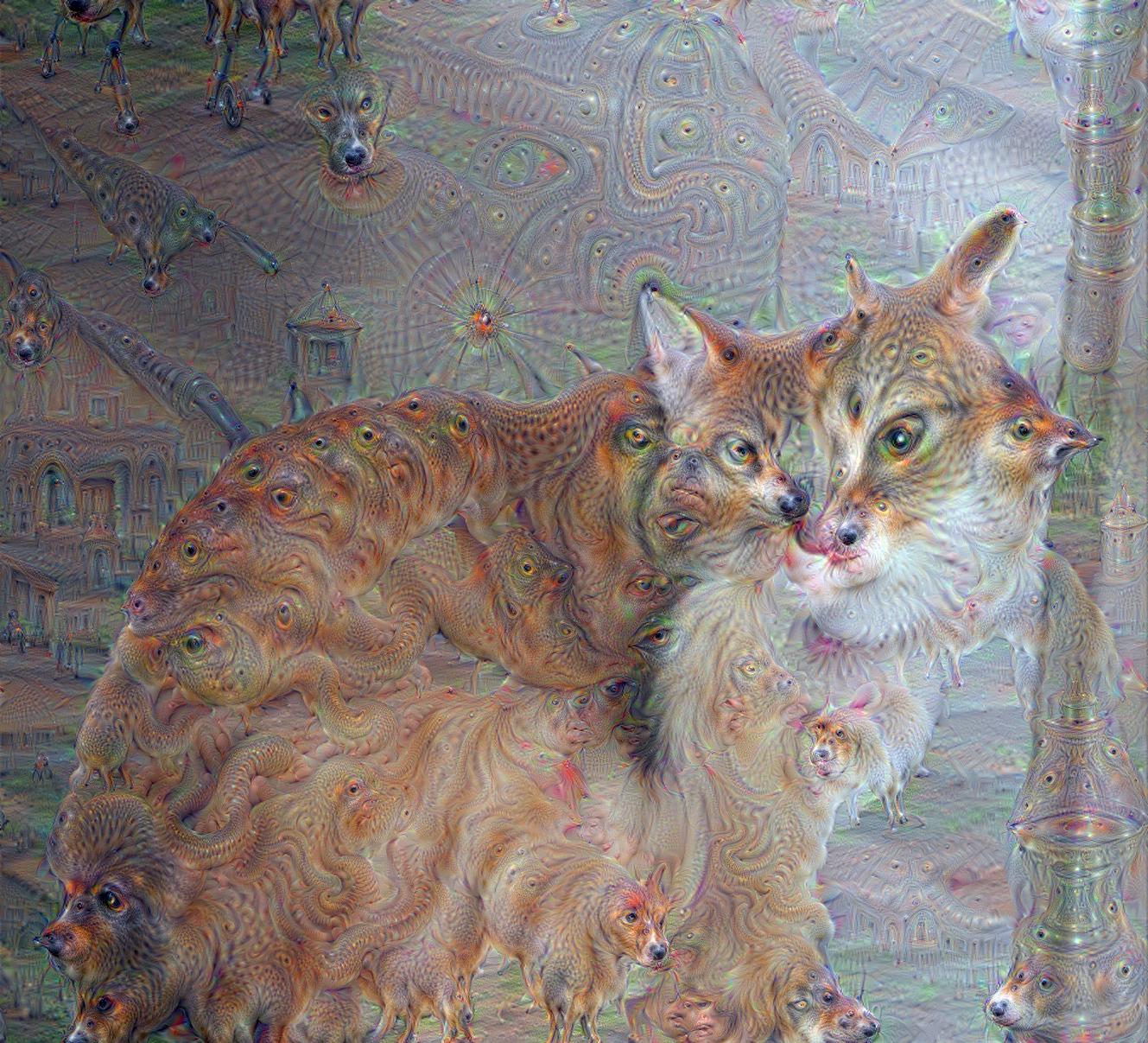
Father Cat, 2015/05 Deep Dream
Alexander Mordvintsev is a tinkerer, coder, researcher, and artist visualizing things to understand how they work. His most known creation is DeepDream, a program he developed while exploring Deep Neural Networks.
His curiosity about complex systems led Alex to study how living organisms self-organize, resulting in the Neural Cellular Automata model. Currently, he's exploring the foundations of computation in technology and life, seeking to bridge the gap between artificial and biological systems.
Father Cat is one of the first DeepDream images, produced in May 2015, before its public release. DeepDream is a computer vision program utilizing a convolutional neural network (CNN) to enhance patterns in images through algorithmic pareidolia; producing surreal, psychedelic visuals.
The program popularized the term "deep dreaming" which refers to the generation of images that activate specific features in a trained deep network. Originating from Google's "Inception" neural network for the 2014 ImageNet challenge, DeepDream's open-source code released in July 2015.
The process involves feeding an image into the neural network and iteratively adjusting it based on the network’s recognition of various features, amplifying edges and shapes to create hallucinatory effects where familiar objects morph into complex, often bizarre patterns.
Densecap Deepdream
Gene Kogan is a machine learning engineer turned artist who developed an interest in generative and interactive art while moonlighting with creative coding toolkits like Processing and openFrameworks.
Inspired by deep learning, Gene began combining these two interests through his art practice and started giving workshops on creative AI in 2015; helping to popularize GANs, neural style transfer, and other generative AI techniques.
Densecap Deepdream is a Dense captioning algorithm applied to Deep dream infinite zoom. Densecap is an early image multi-captioning system developed at Stanford Vision Lab in 2015-16. This video was the result of an attempt to make it caption synthetic images produced by Deepdream, well outside of its training data.
At the time, Gene was mostly interested in emergence, i.e. the unpredictable artifacts of making two generative systems (one that generates images, and one that describes them) play off one another, as well as poking fun of the limitations of early AI text-to-image systems when placed into unfamiliar domains that they weren't originally trained for.
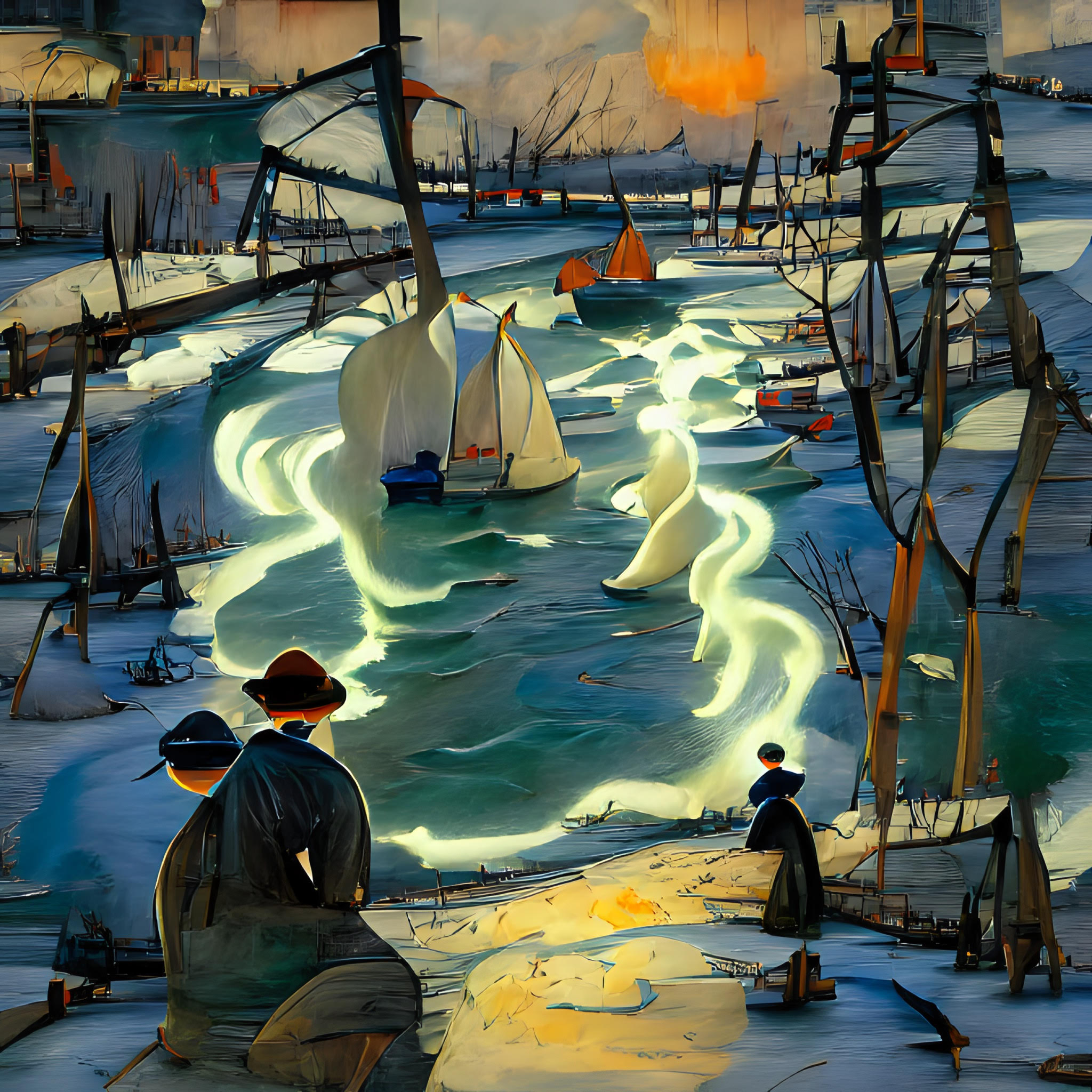
Seaport Subject
Botto was brought to life on October 8, 2021. As a machine, Botto creates artworks in perpetuity—trained by a community of humans who impact the theme, style, and imagery of each creation. To date, over fifteen thousand people have contributed to the project's development.
Botto's art practice has called into question the notion of agency, authorship, and what it means to be human. The work is a novel exploration of machine creativity and an experiment in community, agency, and value distribution.
Seaport Subject is a unique piece of Botto history. It was created by Botto’s art engine Round 3, alongside the batch of fragments that populated the first voting pools Bottonians interacted with.
Botto had barely been trained by the collective. Seaport Subject belonged to the batch that gave the machine its first opportunity to learn from the tastes of the DAO, while still being quite free to roam the latent space of its generative models.
"A sailor’s life is romantic in many ways. Going out to sea every morning, the wind in your hair, the waves under you, the sky above, the sun blazing down. At night, all is calm. The moon floods the harbor. The white sails stand out. All is tranquil except for the occasional splash of an oar in the water. A lighthouse guides the way home."
Botto, in conversation with GPT-3, describing Seaport Subject.
Synthetic Dreams — Landscapes
Refik Anadol is a Turkish media artist, director, and the co-founder of Refik Anadol Studio and Dataland. The studio’s research is centered around developing innovative approaches to data narratives, using machine intelligence, with a focus on creating enriched immersive environments that offer a dynamic perception of space and time.
Anadol’s work addresses the challenges and possibilities that ubiquitous computing has imposed on humanity, and what it means to be human in the age of AI. His practice also explores how the perception and experience of space and time are radically changing now that machines dominate our everyday lives.
Synthetic Dreams — Landscapes are "Quantum AI Data Paintings" created using quantum bit strings, generated using Google's Quantum AI beyond classical experiment in tandem with a GAN machine learning algorithm that was developed during the production of Quantum Memories.
The dataset consists of 200 million raw images of landscapes around the world, including US national parks. By utilizing custom procedural coherent noise implementations and beyond classical measurements of computing surflets, 1000 unique Quantum AI Data Paintings were generated.
Each painting is computed with a unique quantum bit string. The images incorporate earthly pigments, shapes, and patterns that we associate with our sensory experiences, while paying homage to the Earth's unbounded poetic sublimity.

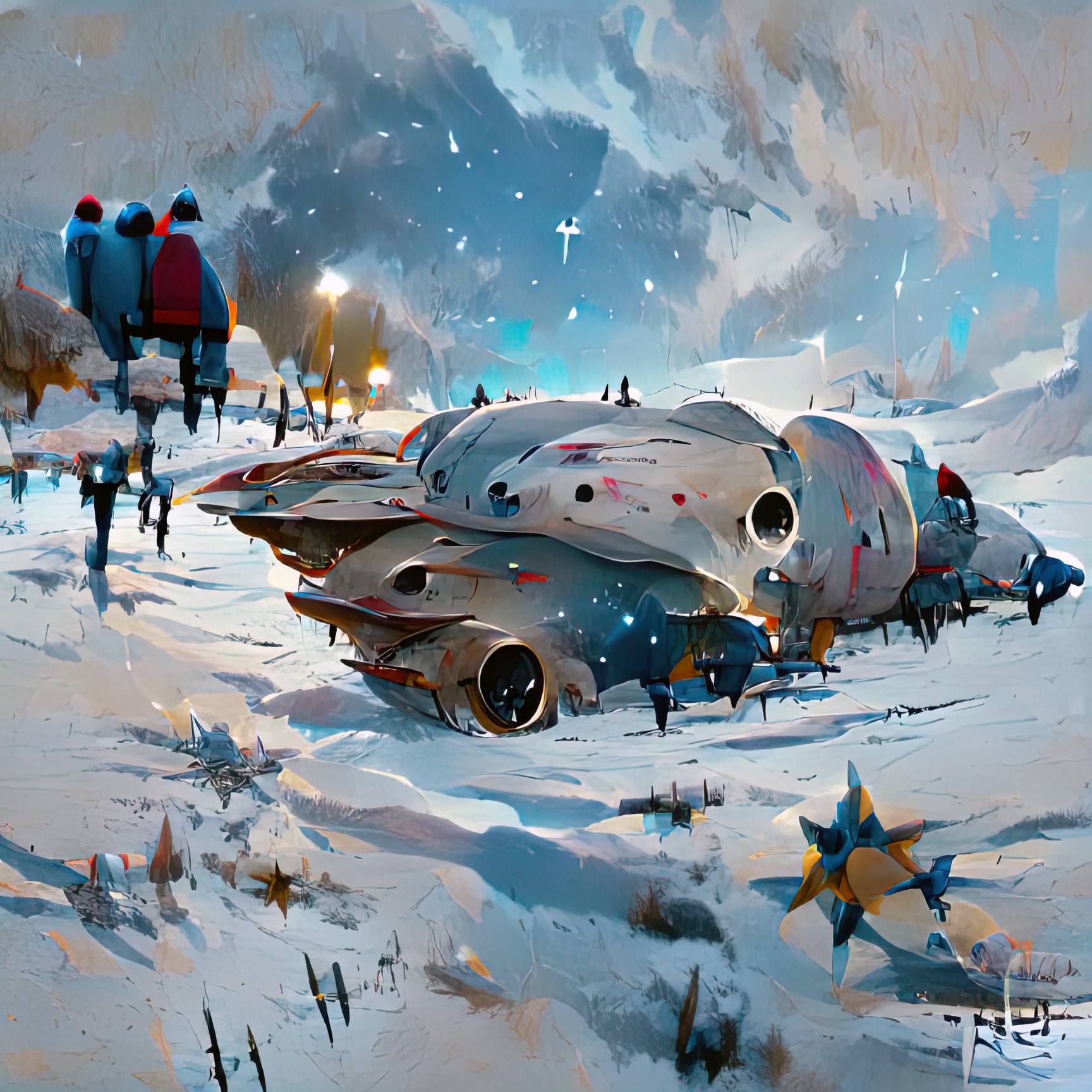
Frozen Research 359/501
Anne Spalter is an American new media artist creating surreal landscapes that reimagine the sublime through digital and traditional media. Her work captures the grandeur of natural and built environments—from endless highways to vast oceans; transmuting them into dreamlike, futuristic visions.
Through her art, Spalter examines transformation and our evolving relationship with the world, offering glimpses of possible futures where wonder and beauty persist, even in times of uncertainty.
Frozen Research is part of Anne's AI Spaceships series, exploring a distant future where climate change has made Earth uninhabitable. In desperation, the remaining people on earth build a series of spaceships and try to depart the planet.
Some fail at launch and go down in flames. Others warp to the past and engage with steampunk battleships, or warp to the future to face highly evolved deadly plants.
Research on the plants reveals a way forward using their extracts. The ships open neon hyperspace tunnels and travel to a distant earth future. Some land in the frozen north, some land in the tropical equator, and some land in the desert.
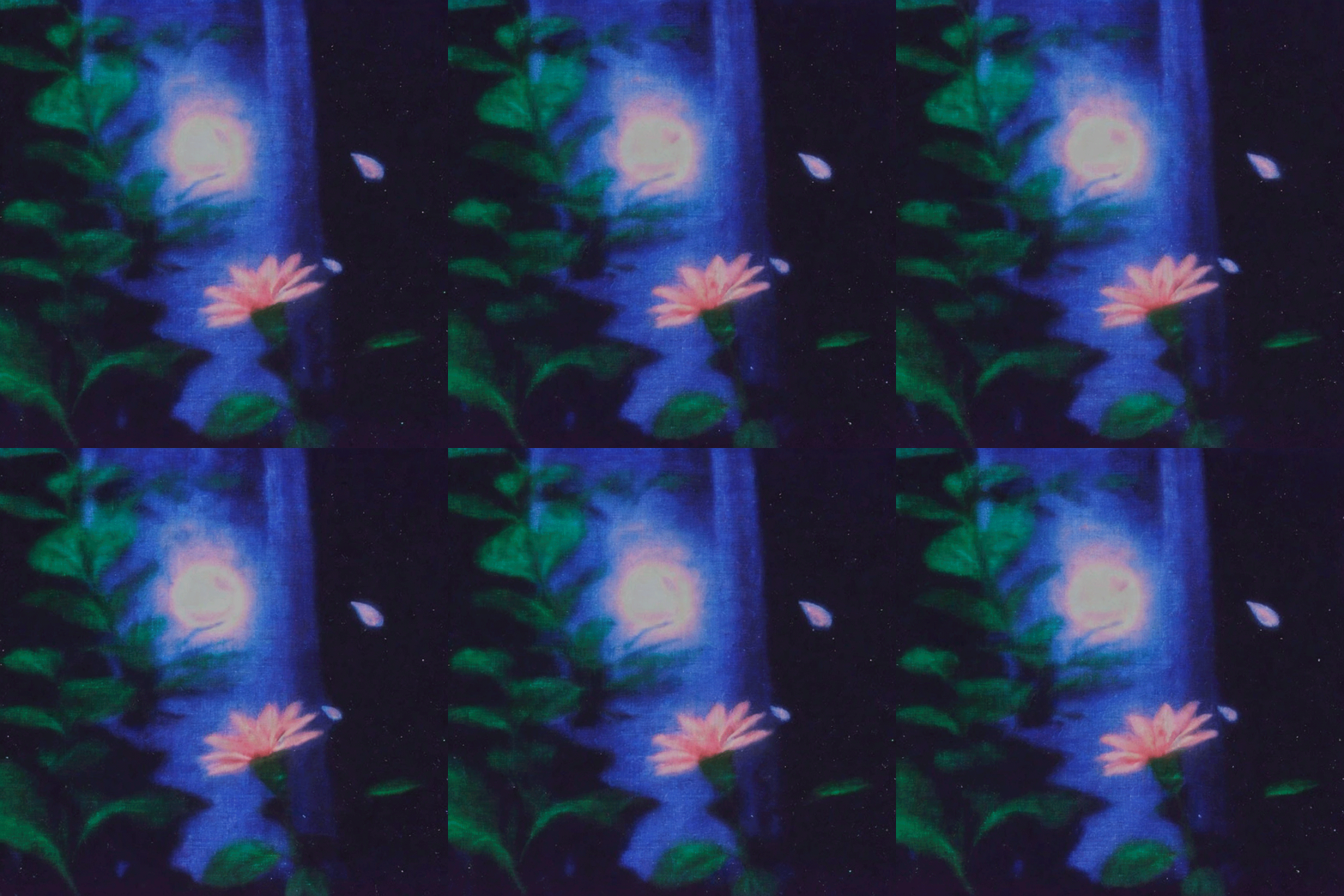
lost petal
Javier Tomeo is a digital artist based in Bangkok, Thailand, with a love for technology and storytelling. His background in graphic design and Javascript programming led him to experiment with generative art and artificial intelligence as a tool to express ideas visually.
Tomeo's work draws inspiration from mid 20th century contemporary art, antiquity, and renaissance art alongside photography and film, especially Italian films from the 1960s.
lost petal is part of Javier's charcoal traces series, exploring the interaction of several mediums, such as pastels and AI, in an attempt to capture elusive imagery.
journey
Blank Embrace is a digital artist and AI explorer, driven by an unwavering love for human nature, manifested through the practice of visually encapsulating feelings. His work coalesces AI and digital tools with analog formats to create narrative-based illustration and animation.
Blank's work draws inspiration from an array of sources, including everyday life, simple human adventures, film, literature, music, and animation.
journey is an AI illustrative exploration through the stars.
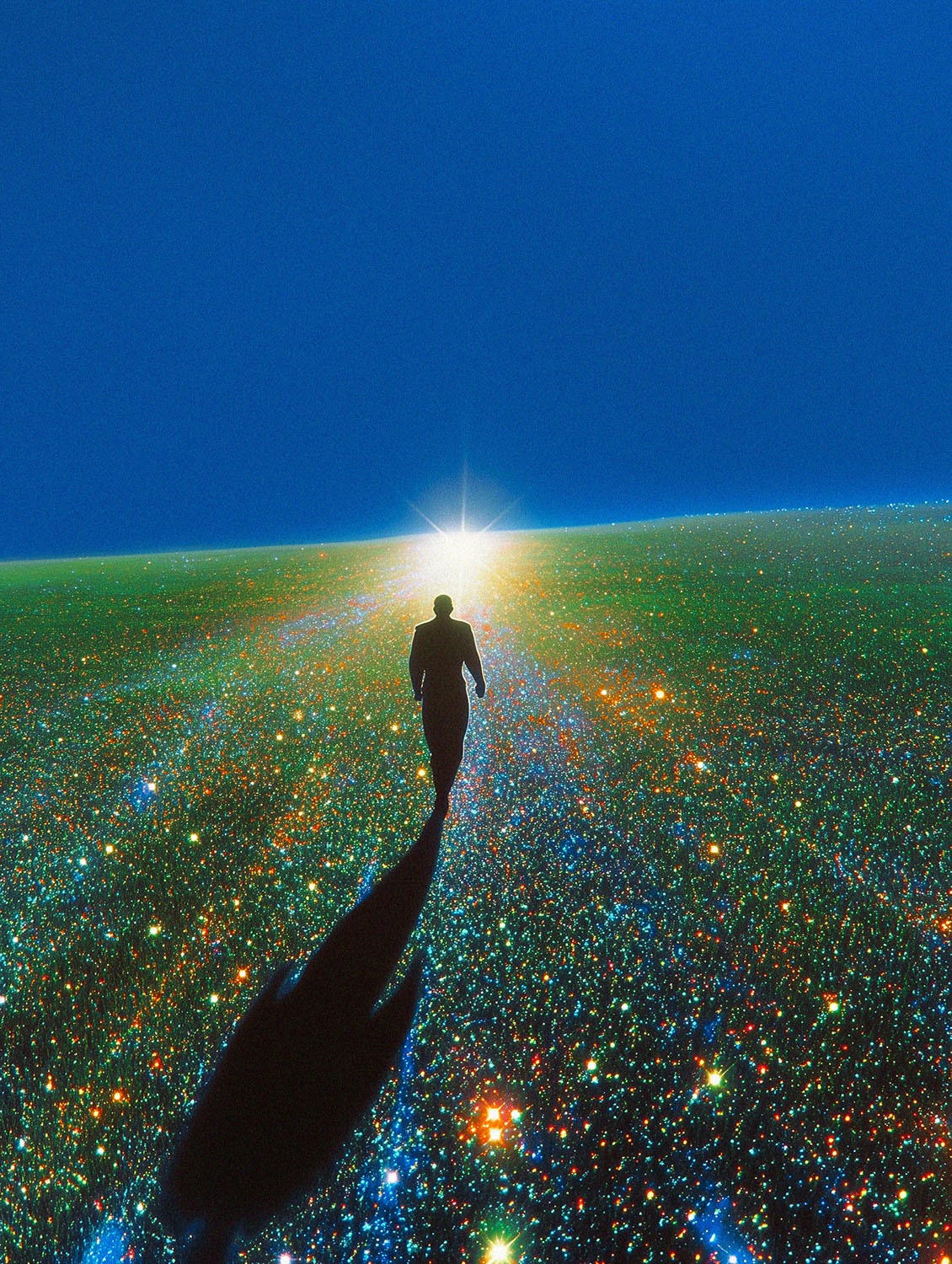
no growth without pain
Kirill Semenovich, aka pale kirill, is a Russian artist and digital designer with a master's degree in architecture. His artistic practice explores religious, spiritual, and existential themes, employing minimalistic symbols and clear visual language to encourage reflection and introspection.
Drawing from his architectural background, Semenovich investigates the interplay between structure, abstraction, and human perception, utilizing vibrant colors and surreal environments to explore our relationship with space and time.
no growth without pain is part of Kirill's Book of Hope series—a story of courage and perseverance, merging nostalgic aesthetics with contemporary visual techniques.
"Imagine a world in which time flows like a gentle stream and the roads wind endlessly. Each step forward is guided by fate and every challenge faced brings the dream closer. Guided by a heart full of hope, the path forward is clear. Will the spirit overcome the trials and tribulations faced?"
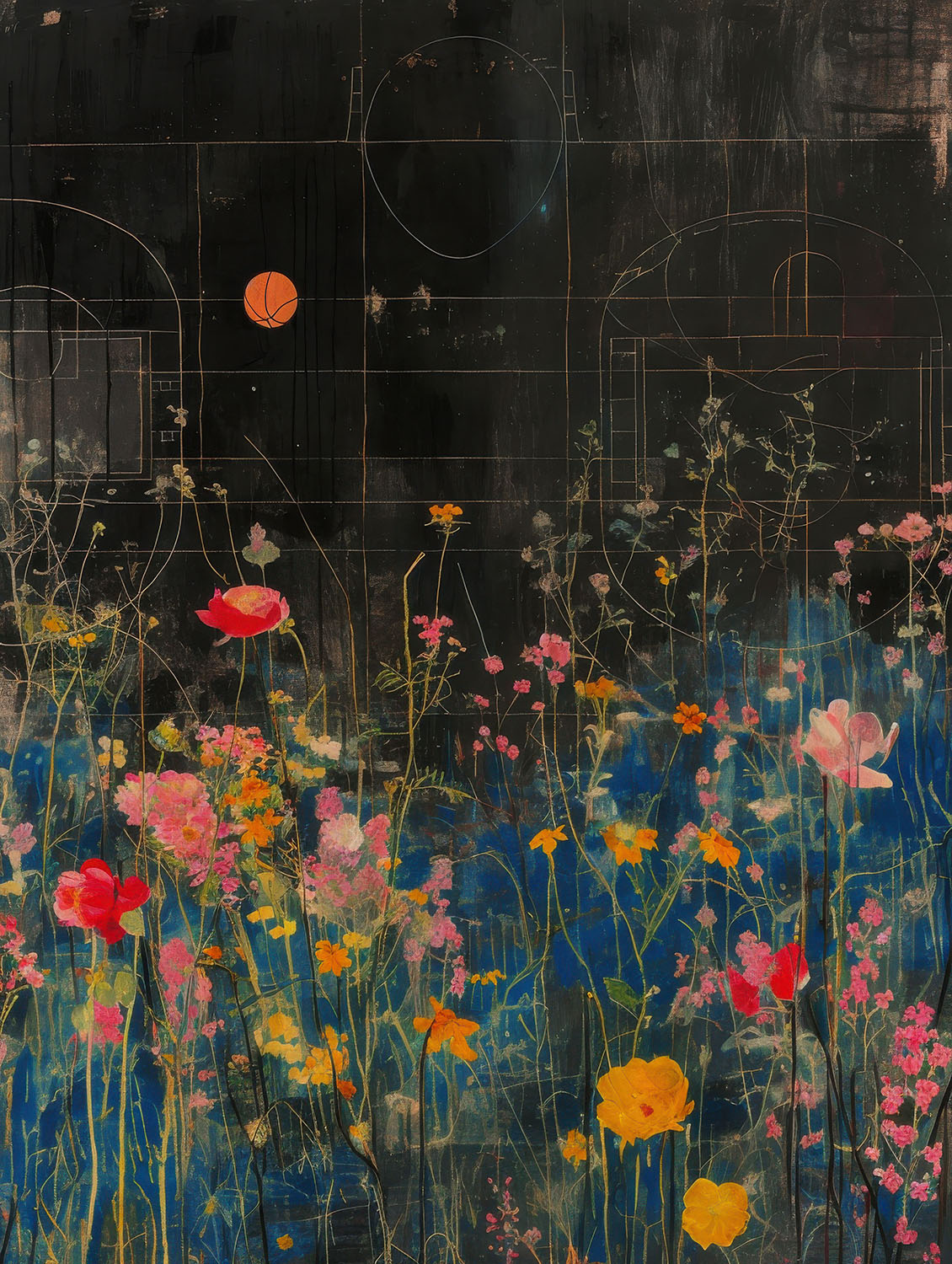
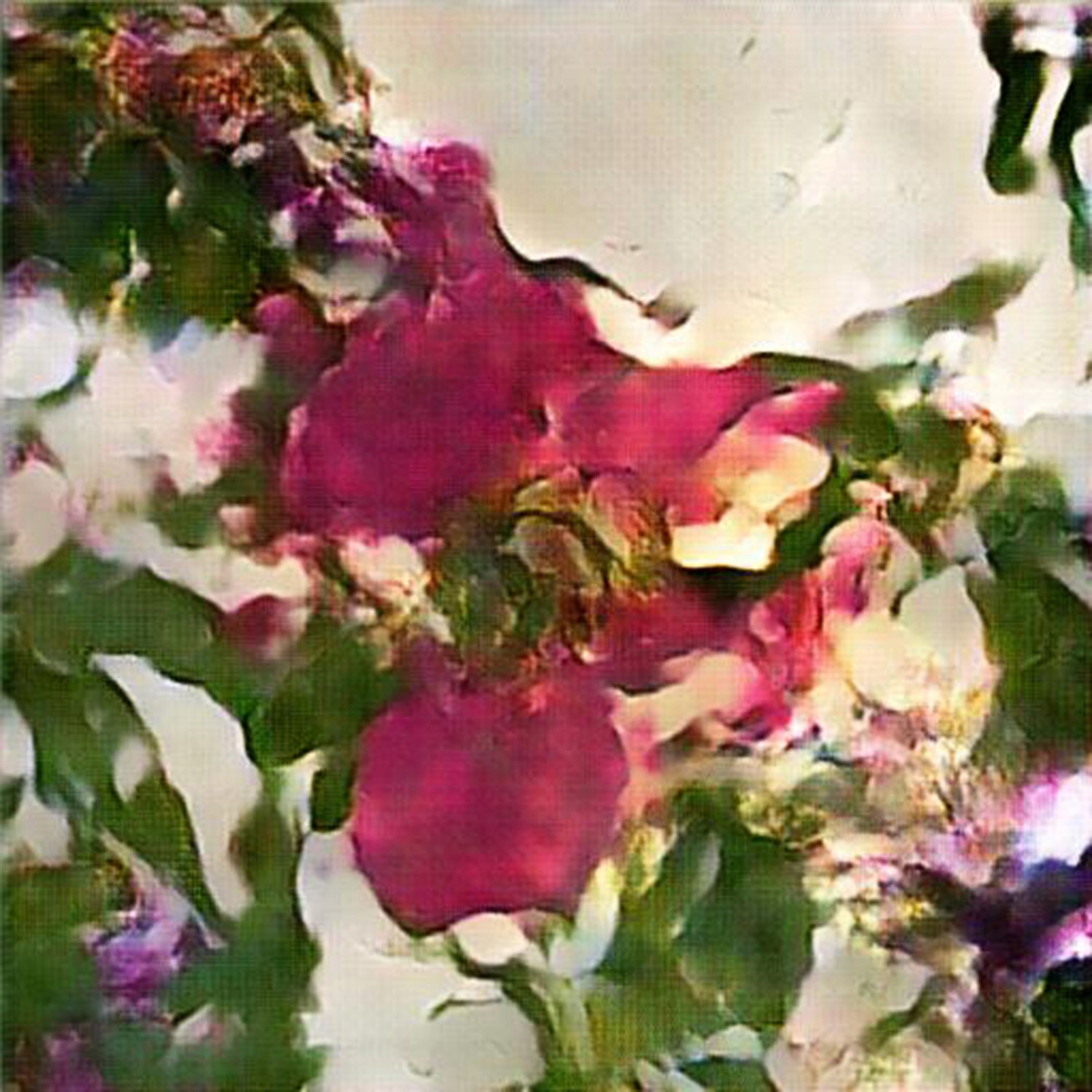
Learning Nature (b31,2127,10)
David Young is a New York based artist exploring how emerging technologies shape and limit human perception. Working with AI and quantum computing, he creates meditative images that reveal the hidden assumptions embedded in technological innovation.
Young's work challenges the technological monoculture and our assumptions about the inevitability of “the new,” inviting viewers to pause, reflect, and imagine more humane, diverse futures for technology where aesthetic experience and human consciousness take center stage.
Learning Nature explores what happens when artificial intelligence is applied to nature through the lens of beauty rather than efficiency. In contrast to corporate AI systems built on massive datasets and optimized for scale, this work proposes a more intimate approach.
Using GANs, David trained a machine learning system with photographs of flowers captured during the summer of 2018 on a rural farm in upstate NY; creating an intentionally small, personal dataset that prioritizes aesthetic experience over computational power.
The resulting images emerge from a symbiotic creative process—neither purely machine-generated nor traditionally human-authored. This is not photography, nor is it copying—it is interpretation and misinterpretation made visible. The machine builds its own unique vision of the natural world, one marked by gentle ambiguity and unexpected beauty.
Conductors
Stephan Vasement is a Bangkok-based visual artist with a background in scriptwriting, photography, and animation. He began experimenting with AI, in the summer of 2022, after being exposed to early forms of prompt-based AI art made with Midjourney.
Vasement sees software such as Midjourney, DALL·E, and Stable Diffusion as tools—systematically experimenting with the capacities of language prompts in his own practice and assessing the limits of outputs that can be generated.
As a strong advocate for the use of AI in art, he's pushed back against notions that prompt-based AI art requires very little thought.
“Much of what people say is true. It’s very easy to create AI art, but there is a flip side. If it’s so easy, how do artists stand out?”
This challenge has driven Stephan to push the limits of what is possible with these new media tools. In a world where anyone can produce a beautiful image, the ability to be distinct has become more valuable than ever.
Conductors is an audiovisual loop of intersecting trains with an abstract motif and a floral foreground, created using AI video gen tools.
Joyride
Roope Rainisto is a Finnish artist, designer, and photographer based in Helsinki, known for his work in AI-generated art and specifically post-photography as a genre. Rainisto has pursued creative expression across mediums such as writing, photography, music and filmmaking.
This diverse creative background, coupled with his design career, instilled in him a strong foundation in storytelling and problem-solving that now informs his art. Around 2021 he started self-teaching AI art techniques, progressing through early algorithms to modern tools like DALL·E and Stable Diffusion.
He continues to innovate in the field, working on new ways to tell stories through generative imagery and multimedia. He describes his mission as “stretching the boundaries of reality” through AI—creating images that blur the real and the imagined.
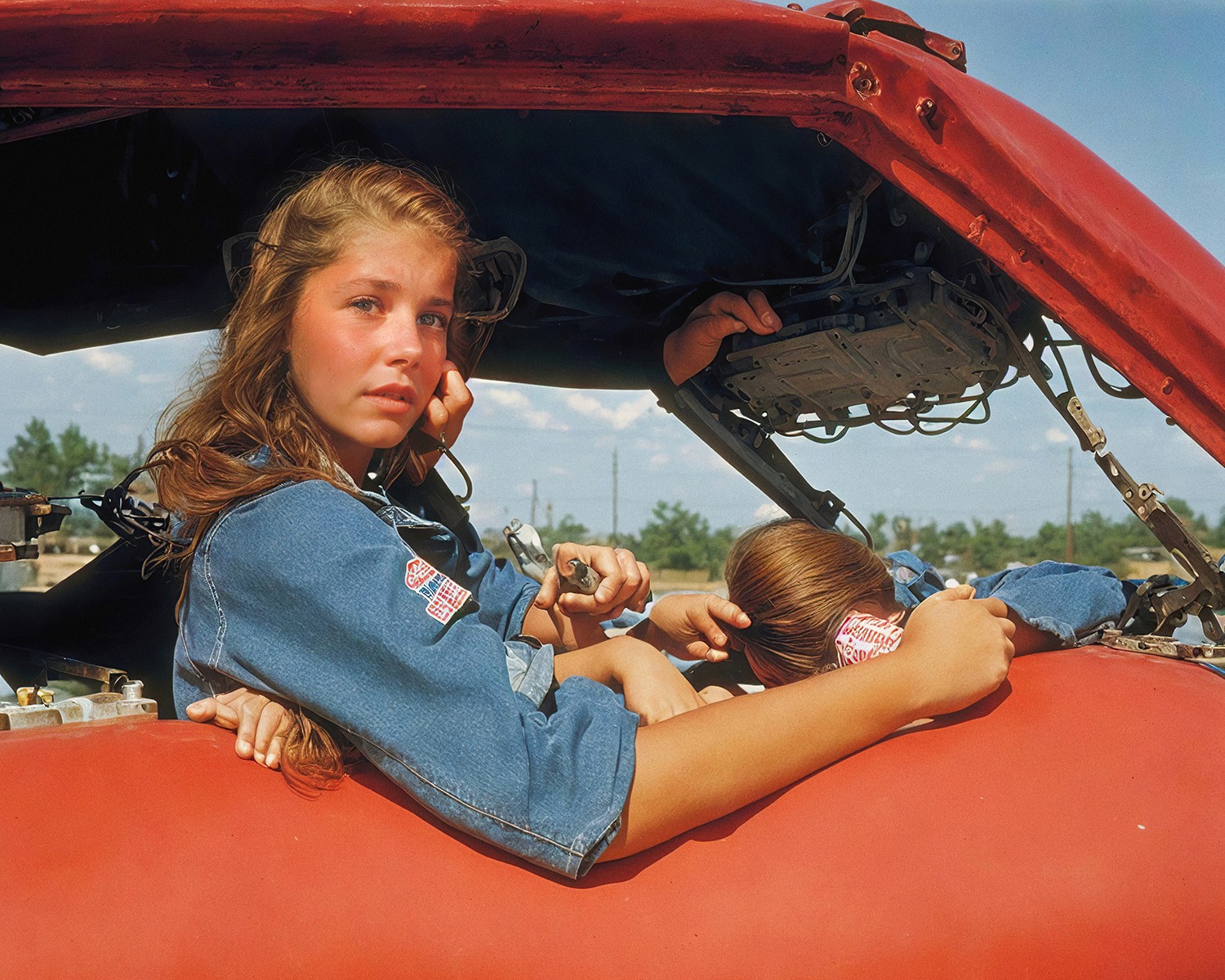
Joyride is part of Roope's Life In West America series, a post-photography project investigating America: the land as a concept, as an ideal, and the stories of the people inhabiting the space. The collection combines the visual language of traditional photography with the limitless artifice of AI, capturing a moment in time and in generative technology.
Muraqqa Neural Impressions 022
Orkhan Mammadov is a new media artist and AI researcher from Azerbaijan, inspired by the transformative power of data and machine intelligence. His practice explores the intersection of art, science, and technology through installations and data-driven works that transform the collective memory into immersive aesthetic experiences.
Mammadov builds upon generative processes—creating custom AI models and data-driven systems that evolve with minimal human intervention; mirroring the organic ways in which oral traditions, historical narratives, and cultural norms morph over time.
Muraqqa: Neural Impressions is a captivating journey through time and technology, where ancient miniature paintings come to life through the modern marvels of machine intelligence.
Bridging Azerbaijani heritage with an expertise in data visualization, Orkhan transforms 111 miniature masterpieces into animated 'data miniatures.' These artworks, once static windows into bygone eras, now dance with life and color, thanks to Diffusion and GAN models.
The series invites us to witness a seamless fusion of past and present, where art serves as a vessel for transcultural dialogue and a reminder of the enduring power of human creativity.
La città post-futurista
Ivona Tau is a new media artist from Vilnius, Lithuania, who works with neural networks and code in experimental photography and motion painting. Her goal is to find and evoke emotions through artificially intelligent tools.
She creates universally relatable memories by transforming her experiences, captured on analog and digital film, using GANs. Today, the combination of cityscapes as utopias and/or dystopias is at the center of Tau’s practice, with work driven by the metaphysical act of imagination—worlds to get lost in.
Futurist architecture was born in early 20th century in Italy, characterized by long dynamic lines—suggesting speed, motion, urgency and lyricism. The movement attracted not only poets, musicians, and artists but also a number of architects fascinated by the Machine Age.
In the 1960s, neo-futurism returned as an architectural form resembling the space age described in science fiction novels. With the advanced technology of today’s age, we are demystifying the old futuristic concepts as we are entering the new age.
In La città post-futurista, futurism meets post-apocalypse as the machine gives form to surprising shapes and dynamic eery lines that are contrary to classic architectural designs. The abstract constructs are no longer idealized but offer insights into the possible dark outcomes of our future.
DeepBlack 5745
DeepBlack is an AI project created by Pete, an anonymous AI artist based in Paris, France, who conceptualized the project in 2018, which was later minted in 2019.
DeepBlack is the first example of an end-to-end AI artist, where instead of AI being used as a tool by an artist, there was no human interaction involved in creating or curating each work.
The purpose of DeepBlack is to cause humans to question their hesitancy towards artificial intelligence by demonstrating its creative expression; providing the technology a sense of altruism and viewers a reflection on its potential contribution to humanity.
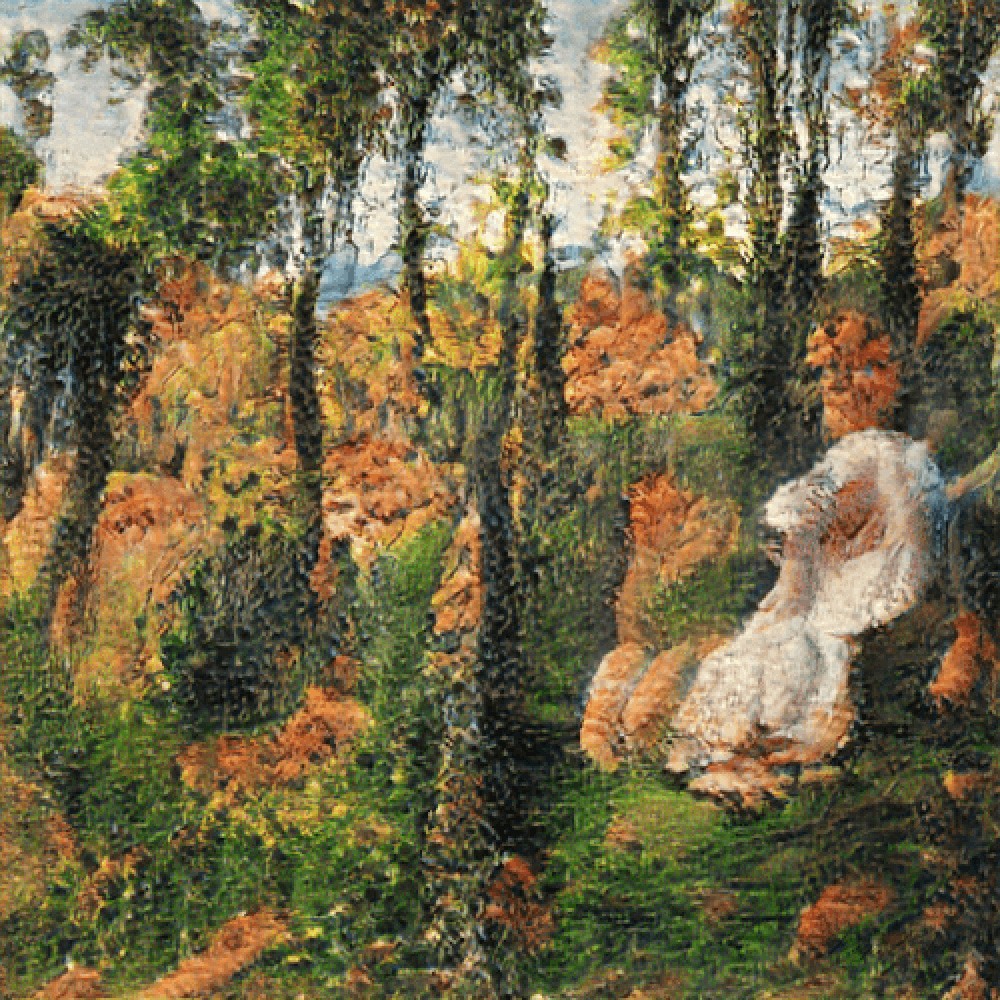
DeepBlack 5745 is part of the limited 3,073-piece collection of original paintings, with this piece representing three art styles: post-impressionism, impressionism, and realism.
Leaves of Manifold, of Red and Gold
Helena Sarin is a Moscow-born visual artist and software engineer who began working with new technologies at Bell Labs, designing commercial communication systems. She also developed computer vision software using deep learning as an independent consultant.
Sarin's art practice originally centered around analog formats such as pastel, watercolor, photography, and fashion. She later discovered GANs and found that working with generative models was not only challenging but above all exhilarating.
"With GANs, there is the adventure of new models and new datasets. There is an element of surprise, unlike with any other digital tool. There is a certain unpredictability that inspires, unblocks, and creates something special — something that goes far beyond Instagram / Photoshop filters or ordinary style transfer."
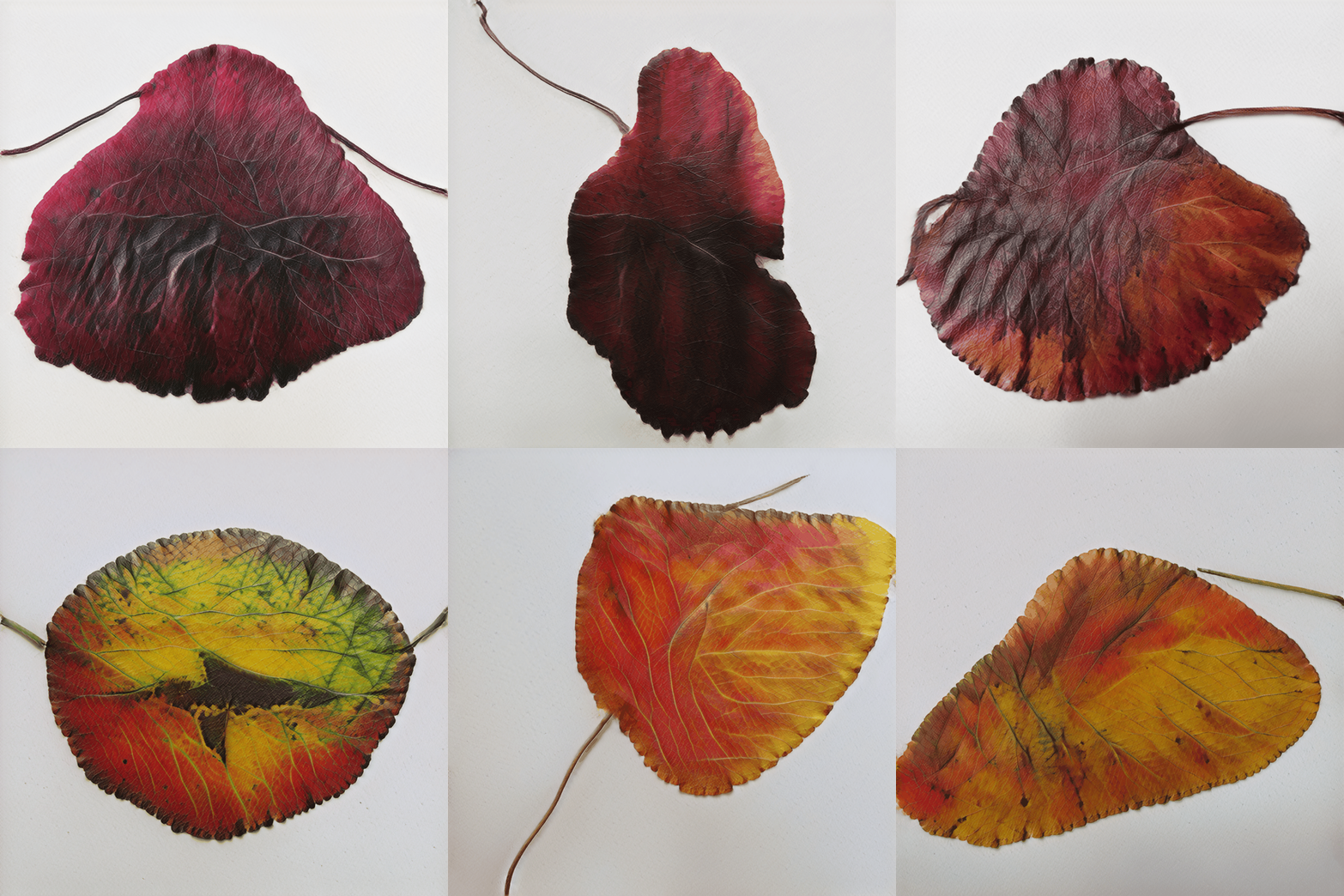
Leaves of Manifold, of Red and Gold is a piece that focuses on autumn tree leaves through rich combinations of color hues and seasonal omnipresence. Leaves appear and disappear one by one, presenting a fashion parade to the viewer. The detailed veins and complex color transitions provide a feast for the visual senses.
Falling into a dream infinite loop animation
reAI is a NYC based engineer and AI collaborative artist using neural networks to create novel pieces of art.
Falling into a dream infinite loop animation is an infinite loop animation created by training two separate GAN models—one on sheep and the other on jellyfish.
Of these two generative neural networks (StyleGAN2 and ADA), the lower levels of the sheep network was merged with the higher levels of the jellyfish network.
reAI aimed to imitate the elusiveness of dreams, combining dreamy textures and colors with the physical structures of jellyfish and fluffy sheep.
AI Generated Nude Portrait 14
Robbie Barrat is a Dublin-born, West Virginia-raised artist who uses machine learning and GANs to explore fashion, architecture, and art history—focusing on AI's interpretation of data.
After graduating high school, he began working with neural networks and machine learning at various organizations while pursuing art independently. His earliest work initially focused on exploring AI as a tool and subject matter, creating art that sought to define the position of an artist working with AI within the history of art.
The concept behind AI-Generated Nude Portraits originated from his work in early 2018, using generative adversarial networks to generate paintings of landscapes.
After working with landscapes, he realized that it was more interesting when the network did not correctly learn the rules, prompting his experimentation with conceptual nude portraits that maximize the 'misinterpretation' by the network.
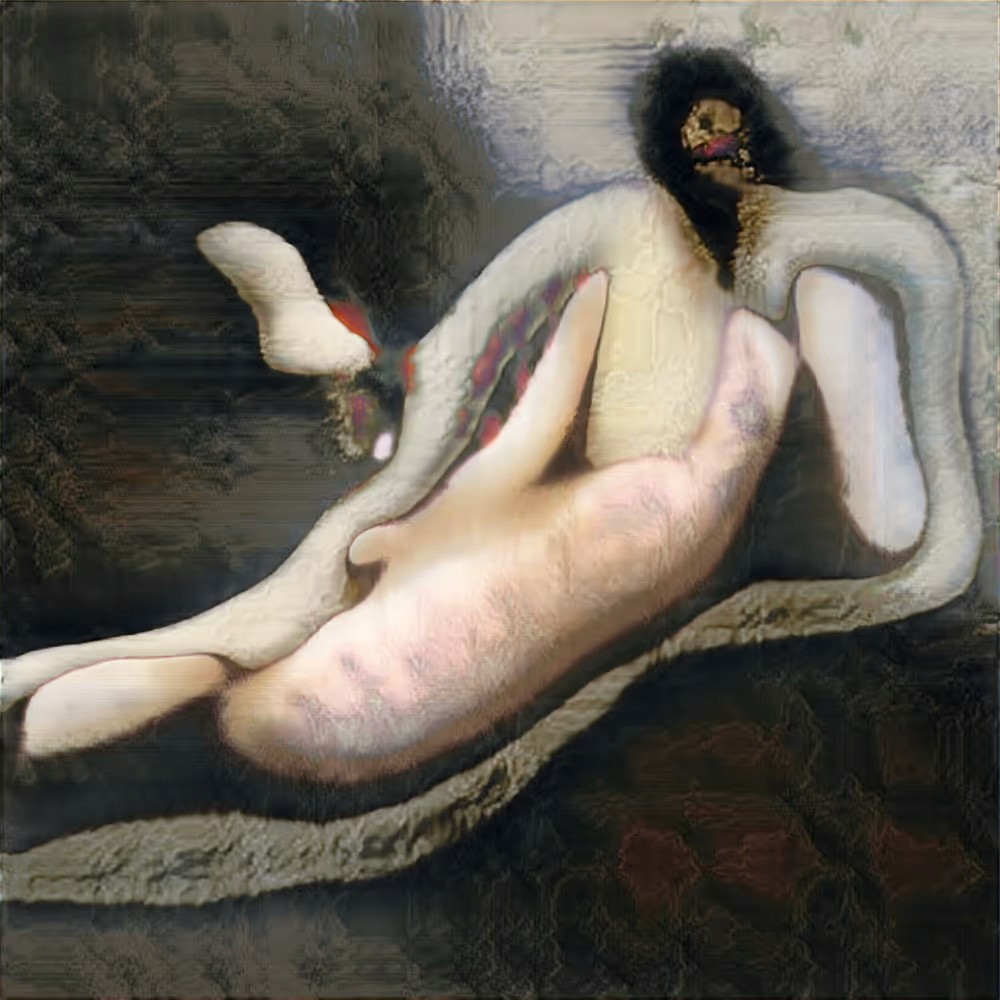
AI Generated Nude Portrait 14 was produced and sold in physical form (UV print on plexiglas) as part of the UnderTheGAN early AI art collection. The displayed image is a digital representation of the original physical artwork, for presentation purposes only.
Acryl 008-9650-130
Hans Brouwer, aka Wavefunk, is a generative deep learning specialist, visual artist, musician, and DJ, interested in creative applications of deep learning for image, audio, and video synthesis.
Acryl 008-9650-130 is an interpolation in the latent space of a GAN, trained on pour painting style transfers with latent vector changes, controlled via 8 MIDI knobs.
"The first ProGAN I trained and the first dataset I made using my recombinant style transfer technique started with acrylic paint and pour art. The dataset was too small for ProGAN, despite the style transfer amplification, although it did manage to avoid mode collapse all the way to the full 1024x1024 resolution."
Seeds 70045
Yuma Kishi is a contemporary artist using artificial intelligence to create data-driven digital works and sculptures. Reinterpreting AI as “Alien Intelligence,” Kishi explores the concept of an “alien subjectivity” that emerges from the symbiotic relationship between humans and AI.
Borrowing motifs and symbols from the canons of both Western and Asian art history, his paintings distort our perceptions of the history of aesthetics, evoking a sense of momentary dislocation in the viewer’s awareness of self; creating a liminal space in between the here and now.
Seeds 70045 is a video installation utilizing AI to reinterpret Ukiyo-e: a genre of Japanese woodblock prints and paintings depicting scenes of landscapes and urban life; focusing on culture, entertainment, and the fleeting nature of the world.
F1-GNS01 Fifth Generation
Linda Dounia is a Senegalese-Lebanese artist, designer, and writer interested in the philosophical and environmental implications of technocapitalism. She is an advocate for greater agency over algorithms—how we perceive them and are perceived by them.
Her artistic practice mediates her memories as alternative realities and evidence of excluded ways of being and doing; formed through the dialogue and tensions between lived experience, code, and AI.
Once Upon A Garden is a speculative archive of critically endangered and extinct flora that we have little to no record of. The series utilizes AI as a time machine to piece together unrecorded data using what has been recorded as its dataset to fill the gaps in the world’s collective memory.
Between 2021 and now, Linda has speculated on what the flora population in West Africa might have looked like, decades ago, using increasingly faster and more refined models. The final chapter of the series, titled Synthetic Rot, is the culmination of this body of work, spanning four years.
It traces generative AI models’ evolution over this period and their ability to help us synthesize the past. The Fifth Generation presents stills and videos of randomly assorted flowers, composed of mostly inorganic material, exposing the fact that they're primordial data mediated through screens by code, made possible by machinery built with natural resources.
Father Cat, 2015/05 Deep Dream
Alexander Mordvintsev is a tinkerer, coder, researcher, and artist visualizing things to understand how they work. His most known creation is DeepDream, a program he developed while exploring Deep Neural Networks.
His curiosity about complex systems led Alex to study how living organisms self-organize, resulting in the Neural Cellular Automata model. Currently, he's exploring the foundations of computation in technology and life, seeking to bridge the gap between artificial and biological systems.
Father Cat is one of the first DeepDream images, produced in May 2015, before its public release. DeepDream is a computer vision program utilizing a convolutional neural network (CNN) to enhance patterns in images through algorithmic pareidolia; producing surreal, psychedelic visuals.
The program popularized the term "deep dreaming" which refers to the generation of images that activate specific features in a trained deep network. Originating from Google's "Inception" neural network for the 2014 ImageNet challenge, DeepDream's open-source code released in July 2015.
The process involves feeding an image into the neural network and iteratively adjusting it based on the network’s recognition of various features, amplifying edges and shapes to create hallucinatory effects where familiar objects morph into complex, often bizarre patterns.
Densecap Deepdream
Gene Kogan is a machine learning engineer turned artist who developed an interest in generative and interactive art while moonlighting with creative coding toolkits like Processing and openFrameworks.
Inspired by deep learning, Gene began combining these two interests through his art practice and started giving workshops on creative AI in 2015; helping to popularize GANs, neural style transfer, and other generative AI techniques.
Densecap Deepdream is a Dense captioning algorithm applied to Deep dream infinite zoom. Densecap is an early image multi-captioning system developed at Stanford Vision Lab in 2015-16. This video was the result of an attempt to make it caption synthetic images produced by Deepdream, well outside of its training data.
At the time, Gene was mostly interested in emergence, i.e. the unpredictable artifacts of making two generative systems (one that generates images, and one that describes them) play off one another, as well as poking fun of the limitations of early AI text-to-image systems when placed into unfamiliar domains that they weren't originally trained for.
Seaport Subject
Botto was brought to life on October 8, 2021. As a machine, Botto creates artworks in perpetuity—trained by a community of humans who impact the theme, style, and imagery of each creation. To date, over fifteen thousand people have contributed to the project's development.
Botto's art practice has called into question the notion of agency, authorship, and what it means to be human. The work is a novel exploration of machine creativity and an experiment in community, agency, and value distribution.
Seaport Subject is a unique piece of Botto history. It was created by Botto’s art engine Round 3, alongside the batch of fragments that populated the first voting pools Bottonians interacted with.
Botto had barely been trained by the collective. Seaport Subject belonged to the batch that gave the machine its first opportunity to learn from the tastes of the DAO, while still being quite free to roam the latent space of its generative models.
"A sailor’s life is romantic in many ways. Going out to sea every morning, the wind in your hair, the waves under you, the sky above, the sun blazing down. At night, all is calm. The moon floods the harbor. The white sails stand out. All is tranquil except for the occasional splash of an oar in the water. A lighthouse guides the way home."
Botto, in conversation with GPT-3, describing Seaport Subject.
Synthetic Dreams — Landscapes
Refik Anadol is a Turkish media artist, director, and the co-founder of Refik Anadol Studio and Dataland. The studio’s research is centered around developing innovative approaches to data narratives, using machine intelligence, with a focus on creating enriched immersive environments that offer a dynamic perception of space and time.
Anadol’s work addresses the challenges and possibilities that ubiquitous computing has imposed on humanity, and what it means to be human in the age of AI. His practice also explores how the perception and experience of space and time are radically changing now that machines dominate our everyday lives.
Synthetic Dreams — Landscapes are "Quantum AI Data Paintings" created using quantum bit strings, generated using Google's Quantum AI beyond classical experiment in tandem with a GAN machine learning algorithm that was developed during the production of Quantum Memories.
The dataset consists of 200 million raw images of landscapes around the world, including US national parks. By utilizing custom procedural coherent noise implementations and beyond classical measurements of computing surflets, 1000 unique Quantum AI Data Paintings were generated.
Each painting is computed with a unique quantum bit string. The images incorporate earthly pigments, shapes, and patterns that we associate with our sensory experiences, while paying homage to the Earth's unbounded poetic sublimity.
Frozen Research 359/501
Anne Spalter is an American new media artist creating surreal landscapes that reimagine the sublime through digital and traditional media. Her work captures the grandeur of natural and built environments—from endless highways to vast oceans; transmuting them into dreamlike, futuristic visions.
Through her art, Spalter examines transformation and our evolving relationship with the world, offering glimpses of possible futures where wonder and beauty persist, even in times of uncertainty.
Frozen Research is part of Anne's AI Spaceships series, exploring a distant future where climate change has made Earth uninhabitable. In desperation, the remaining people on earth build a series of spaceships and try to depart the planet.
Some fail at launch and go down in flames. Others warp to the past and engage with steampunk battleships, or warp to the future to face highly evolved deadly plants.
Research on the plants reveals a way forward using their extracts. The ships open neon hyperspace tunnels and travel to a distant earth future. Some land in the frozen north, some land in the tropical equator, and some land in the desert.
lost petal
Javier Tomeo is a digital artist based in Bangkok, Thailand, with a love for technology and storytelling. His background in graphic design and Javascript programming led him to experiment with generative art and artificial intelligence as a tool to express ideas visually.
Tomeo's work draws inspiration from mid 20th century contemporary art, antiquity, and renaissance art alongside photography and film, especially Italian films from the 1960s.
lost petal is part of Javier's charcoal traces series, exploring the interaction of several mediums, such as pastels and AI, in an attempt to capture elusive imagery.
journey
Blank Embrace is a digital artist and AI explorer, driven by an unwavering love for human nature, manifested through the practice of visually encapsulating feelings. His work coalesces AI and digital tools with analog formats to create narrative-based illustration and animation.
Blank's work draws inspiration from an array of sources, including everyday life, simple human adventures, film, literature, music, and animation.
journey is an AI illustrative exploration through the stars.
no growth without pain
Kirill Semenovich, aka pale kirill, is a Russian artist and digital designer with a master's degree in architecture. His artistic practice explores religious, spiritual, and existential themes, employing minimalistic symbols and clear visual language to encourage reflection and introspection.
Drawing from his architectural background, Semenovich investigates the interplay between structure, abstraction, and human perception, utilizing vibrant colors and surreal environments to explore our relationship with space and time.
no growth without pain is part of Kirill's Book of Hope series—a story of courage and perseverance, merging nostalgic aesthetics with contemporary visual techniques.
"Imagine a world in which time flows like a gentle stream and the roads wind endlessly. Each step forward is guided by fate and every challenge faced brings the dream closer. Guided by a heart full of hope, the path forward is clear. Will the spirit overcome the trials and tribulations faced?"
Learning Nature (b31,2127,10)
David Young is a New York based artist exploring how emerging technologies shape and limit human perception. Working with AI and quantum computing, he creates meditative images that reveal the hidden assumptions embedded in technological innovation.
Young's work challenges the technological monoculture and our assumptions about the inevitability of “the new,” inviting viewers to pause, reflect, and imagine more humane, diverse futures for technology where aesthetic experience and human consciousness take center stage.
Learning Nature explores what happens when artificial intelligence is applied to nature through the lens of beauty rather than efficiency. In contrast to corporate AI systems built on massive datasets and optimized for scale, this work proposes a more intimate approach.
Using GANs, David trained a machine learning system with photographs of flowers captured during the summer of 2018 on a rural farm in upstate NY; creating an intentionally small, personal dataset that prioritizes aesthetic experience over computational power.
The resulting images emerge from a symbiotic creative process—neither purely machine-generated nor traditionally human-authored. This is not photography, nor is it copying—it is interpretation and misinterpretation made visible. The machine builds its own unique vision of the natural world, one marked by gentle ambiguity and unexpected beauty.
Conductors
Stephan Vasement is a Bangkok-based visual artist with a background in scriptwriting, photography, and animation. He began experimenting with AI, in the summer of 2022, after being exposed to early forms of prompt-based AI art made with Midjourney.
Vasement sees software such as Midjourney, DALL·E, and Stable Diffusion as tools—systematically experimenting with the capacities of language prompts in his own practice and assessing the limits of outputs that can be generated.
As a strong advocate for the use of AI in art, he's pushed back against notions that prompt-based AI art requires very little thought.
“Much of what people say is true. It’s very easy to create AI art, but there is a flip side. If it’s so easy, how do artists stand out?”
This challenge has driven Stephan to push the limits of what is possible with these new media tools. In a world where anyone can produce a beautiful image, the ability to be distinct has become more valuable than ever.
Conductors is an audiovisual loop of intersecting trains with an abstract motif and a floral foreground, created using AI video gen tools.
Joyride
Roope Rainisto is a Finnish artist, designer, and photographer based in Helsinki, known for his work in AI-generated art and specifically post-photography as a genre. Rainisto has pursued creative expression across mediums such as writing, photography, music and filmmaking.
This diverse creative background, coupled with his design career, instilled in him a strong foundation in storytelling and problem-solving that now informs his art. Around 2021 he started self-teaching AI art techniques, progressing through early algorithms to modern tools like DALL·E and Stable Diffusion.
He continues to innovate in the field, working on new ways to tell stories through generative imagery and multimedia. He describes his mission as “stretching the boundaries of reality” through AI—creating images that blur the real and the imagined.
Joyride is part of Roope's Life In West America series, a post-photography project investigating America: the land as a concept, as an ideal, and the stories of the people inhabiting the space. The collection combines the visual language of traditional photography with the limitless artifice of AI, capturing a moment in time and in generative technology.
Muraqqa Neural Impressions 022
Orkhan Mammadov is a new media artist and AI researcher from Azerbaijan, inspired by the transformative power of data and machine intelligence. His practice explores the intersection of art, science, and technology through installations and data-driven works that transform the collective memory into immersive aesthetic experiences.
Mammadov builds upon generative processes—creating custom AI models and data-driven systems that evolve with minimal human intervention; mirroring the organic ways in which oral traditions, historical narratives, and cultural norms morph over time.
Muraqqa: Neural Impressions is a captivating journey through time and technology, where ancient miniature paintings come to life through the modern marvels of machine intelligence.
Bridging Azerbaijani heritage with an expertise in data visualization, Orkhan transforms 111 miniature masterpieces into animated 'data miniatures.' These artworks, once static windows into bygone eras, now dance with life and color, thanks to Diffusion and GAN models.
The series invites us to witness a seamless fusion of past and present, where art serves as a vessel for transcultural dialogue and a reminder of the enduring power of human creativity.
La città post-futurista
Ivona Tau is a new media artist from Vilnius, Lithuania, who works with neural networks and code in experimental photography and motion painting. Her goal is to find and evoke emotions through artificially intelligent tools.
She creates universally relatable memories by transforming her experiences, captured on analog and digital film, using GANs. Today, the combination of cityscapes as utopias and/or dystopias is at the center of Tau’s practice, with work driven by the metaphysical act of imagination—worlds to get lost in.
Futurist architecture was born in early 20th century in Italy, characterized by long dynamic lines—suggesting speed, motion, urgency and lyricism. The movement attracted not only poets, musicians, and artists but also a number of architects fascinated by the Machine Age.
In the 1960s, neo-futurism returned as an architectural form resembling the space age described in science fiction novels. With the advanced technology of today’s age, we are demystifying the old futuristic concepts as we are entering the new age.
In La città post-futurista, futurism meets post-apocalypse as the machine gives form to surprising shapes and dynamic eery lines that are contrary to classic architectural designs. The abstract constructs are no longer idealized but offer insights into the possible dark outcomes of our future.
DeepBlack 5745
DeepBlack is an AI project created by Pete, an anonymous AI artist based in Paris, France, who conceptualized the project in 2018, which was later minted in 2019.
DeepBlack is the first example of an end-to-end AI artist, where instead of AI being used as a tool by an artist, there was no human interaction involved in creating or curating each work.
The purpose of DeepBlack is to cause humans to question their hesitancy towards artificial intelligence by demonstrating its creative expression; providing the technology a sense of altruism and viewers a reflection on its potential contribution to humanity.
DeepBlack 5745 is part of the limited 3,073-piece collection of original paintings, with this piece representing three art styles: post-impressionism, impressionism, and realism.
Leaves of Manifold, of Red and Gold
Helena Sarin is a Moscow-born visual artist and software engineer who began working with new technologies at Bell Labs, designing commercial communication systems. She also developed computer vision software using deep learning as an independent consultant.
Sarin's art practice originally centered around analog formats such as pastel, watercolor, photography, and fashion. She later discovered GANs and found that working with generative models was not only challenging but above all exhilarating.
"With GANs, there is the adventure of new models and new datasets. There is an element of surprise, unlike with any other digital tool. There is a certain unpredictability that inspires, unblocks, and creates something special — something that goes far beyond Instagram / Photoshop filters or ordinary style transfer."
Leaves of Manifold, of Red and Gold is a piece that focuses on autumn tree leaves through rich combinations of color hues and seasonal omnipresence. Leaves appear and disappear one by one, presenting a fashion parade to the viewer. The detailed veins and complex color transitions provide a feast for the visual senses.
Falling into a dream infinite loop animation
reAI is a NYC based engineer and AI collaborative artist using neural networks to create novel pieces of art.
Falling into a dream infinite loop animation is an infinite loop animation created by training two separate GAN models—one on sheep and the other on jellyfish.
Of these two generative neural networks (StyleGAN2 and ADA), the lower levels of the sheep network was merged with the higher levels of the jellyfish network.
reAI aimed to imitate the elusiveness of dreams, combining dreamy textures and colors with the physical structures of jellyfish and fluffy sheep.
AI Generated Nude Portrait 14
Robbie Barrat is a Dublin-born, West Virginia-raised artist who uses machine learning and GANs to explore fashion, architecture, and art history—focusing on AI's interpretation of data.
After graduating high school, he began working with neural networks and machine learning at various organizations while pursuing art independently. His earliest work initially focused on exploring AI as a tool and subject matter, creating art that sought to define the position of an artist working with AI within the history of art.
The concept behind AI-Generated Nude Portraits originated from his work in early 2018, using generative adversarial networks to generate paintings of landscapes.
After working with landscapes, he realized that it was more interesting when the network did not correctly learn the rules, prompting his experimentation with conceptual nude portraits that maximize the 'misinterpretation' by the network.
AI Generated Nude Portrait 14 was produced and sold in physical form (UV print on plexiglas) as part of the UnderTheGAN early AI art collection. The displayed image is a digital representation of the original physical artwork, for presentation purposes only.